Saturday, February 1, 2014

Unique Behaviour Seen Among Lions In Gir Sanctuary

Unique Behaviour Seen Among Lions In Gir Sanctuary

Hasrat Khokhar [ Updated 31 Dec 2011, 10:32:18 ]
Unique Behaviour Seen Among Lions In Gir Sanctuary
FONT SIZE
Junagarh City, Gujarat, Dec 31: A four-year-old lioness sits alone staring at her brother who is being chased out of the group by her father.

The foresters cannot but marvel at the human reaction of this young lioness to the domestic squabble. She stops eating till her brother returns back to the pride.


Not just the sister, but the other sub-adults too move away from the group and refuse food unless he returns.
 
But soon they will realize the hard fact that the young lion has to move out of the pride and establish his own kingdom, say the officials.


This unique behavioral pattern has been spotted in a huge pride of 32 lions, the biggest in Gir sanctuary.

The foresters who keep a watch and document the behaviour of these big cats are surprised by the nuances of inter-personal relationships and bonding displayed by these Gir lions.


Deputy conservator of forest, Sandeep Kumar who is documenting the behaviour of this group said, "It is time for the young ones to move out of the group and have own territory in the next couple of months. The sub-adult male now has to prove his supremacy before the next breeding season, which begins in February."

However the sub-adult male, who is very attached to the parent group, does not venture out much. But the father and uncle are adamant that he establishes his own territory.

Kumar said, "When the father and uncle chase away this sub-adult, his sister of the same age too runs away from the group in protest, as she gets emotional. She sits away from the group for hours together staring in the direction where her brother has gone."


This is one of the biggest prides in the Gir sanctuary or even in the state. The pride comprises of seven sub groups covering an area of 135 sq km. This pride is often spotted in the tourism zone and is commonly known as Dedakadi group. Dedakadi is an area in Gir Sanctuary.

The pride of 32 consists of two male lions, about 13-14 years of age and who dominate the group, nine adult female and ten sub-adult female and 11 cubs of less then three years of age.
 
The two lions have not allowed any intruder in their territory for the past seven years. This 135 sq km area comprises of Malanka, Kasia and Keramba.

The Forest of Gir is well known universally. There is a kingdom of lions (Phanthera eo persica). These lions are also called as Asiatic Lions.


There is an increase in the lion population in the Gir forest. Today, more than 411 lions roam the Gir forest.
 
This could be the result of better protection and management inputs given by the forest department.
 
The protection and management significantly increased the lion prey population, water availability, and habitat improvement in the area.


In the Asiatic lions, a group having 2 adult males and several females with their cubs is called a pride. Here, two males together guard a territory; under which two or more female’s territories comes that is called sub-group.
 
A sub-group formed by 1 to 3 adult females, their cubs, and sub-adults of previous litters. Adult males regularly visit these sub-groups and father the most of the cubs.

Monday, April 22, 2013

Gir villages shut for a day for ‘their’ lions

Gir villages shut for a day for ‘their’ lions


A


Days after the Supreme Court ordered for the trans-location of Asiatic lions from Gir forests to Madhya Pradesh, Sasan, the well-known destination for lion safaris, and other villages bordering the wildlife sanctuary observed a bandh and submitted a memorandum to the local revenue officer.
Hotel owners of Sasan and local shopkeepers took out a rally in the village and they were joined by residents of nearby villages like Chitrod, Bhjde and Vihvel.
Sasan is a village on the boundary of Gir sanctuary and is the main entry point to it.
Volunteers of NGO Prakruti Nature Club of Kodinar and Environment Protection Committee, another NGO based in nearby Veraval town, also took part in the rally.
Later in the day, the protesters drove in a cavalcade of Maruti Gypsies, used for safaris, to Talala town and submitted a memorandum to mamlatdar demanding that the state government file a review petition in the apex court against its Monday verdict.
"Lion-based tourism is the only means of livelihood for residents of all these villages. If lions are trans-located to Madhya Pradesh, we shall lose tourists and in turn our means of sustenance. Hence we demand the state government file a review petition in the Supreme Court," Khimji Sandera, president of Sasan Gypsy Association, told The Indian Express over phone.
During the day-long shutdown, shops and many hotels in the Sasan remained closed while no lion safari was organised. However, Sandera said they would resume work from Friday but their fight against sending Asiatic lions from their only habitat in Gir to Madhya Pradesh would continue.


Gujarat loves its lions


Gujarat loves its lions


Gujarat loves its lions


No sooner did the news about the Supreme Court verdict to relocate the Asiatic lions from Gujarat to Madhya Pradesh came, that rejoicing in the mainstream media began. Yet another ‘Blow to Modi’ series of headlines found its way to news streams across media outlets. This is fully understandable, considering the fact that in this day and age, Modi has come to mean TRPs for TV channels, as was rightly pointed out by Shailaja Bajpai in the Indian Express. Sadly though, much of the reportage reflects an abject ignorance of facts and a poverty of coherent arguments. Pettiness has come to define most of the news analysis and reporting on every issue related to Gujarat. A perfect example of that was a report in the Times of India, which took the battle over the Asiatic Lion to the Den of another Gujarati lion sitting in Gandhinagar, Narendra Modi.
My problem with the article is not that it takes a stand that is against any particular person. Everyone is free to take any stand as he or she feels. The problem is that the article is built entirely on false premises! While the article claims otherwise, one must look towards the commendable legal action the Gujarat Government took, backed by a solid effort in conserving the lion since the last decade. At the same time, it is indeed unfortunate that the courts have interfered in an area such as this. It would have been appropriate if things were left to the local Government in the spirit of federalism. The Court evidently did not think this to be important and the media did not attach importance to the efforts of the State Government to keep the lion in its original home.
The fight by Gujarat Government to keep the lion in its original home
If the ToI article and large sections of the media are to be believed, the legal fight that the Gujarat Government put up was weak! Nothing can be more ridiculous than this. Can anyone consider engaging Harish Salve, Shyam Diwan and Mukul Rohatgi as ‘weak’? Salve and Rohatgi are already well-known faces. And for those who do not know, Shyam Diwan is an expert in the field who has even authored a book titledEnvironmental Law and Policy in India. Lawyer friends in the Capital also say that the matter was dealt with full conviction and commitment by Gujarat’s legal team.
A weak leadership, political will and bureaucracy… or not?
The other reason attributed is a lack of interest among the political leadership and the bureaucracy. This news can make anyone fall off their couch with laughter! In fact, the Times of India news item on the matter itself is self-contradictory. It says in a different paragraph that this case was being monitored by the Chief Minister’s Office directly. Hence, the statement that Modi’s leadership uprooted the lions is not only totally incorrect, but also smells of ulterior motives. The news reports have clearly not been able to explain how the political leadership lacks interest. To defend the case, as many as seven affidavits have been filed in the matter by the State Government. Five affidavits have been filed by the Principal Chief Conservator of Forests (Wildlife), Gujarat State. The remaining two have been filed by the Deputy Secretary, Forests & Environment, Government of Gujarat. The affidavits have been discussed and examined at various levels before filing, they have handled various technical and managerial issues very meticulously. In fact, as chronicled in the judgment (15-04-2013) of the Supreme Court itself, the matter has been twice referred back to the National Board for Wildlife (NBWL) due to representation by the Government of Gujarat. Further, the matter has also been referred to the State Board for Wildlife (SBWL) due to representation by Gujarat itself. It is pointed out that the various affidavits made by Gujarat deal with the issue very comprehensively covering legal, technical, scientific and socio-cultural aspects. The arguments were adequately supported with facts, figures, data and scientific papers. It is also pointed out that every hearing in the Court, every briefing and every meeting (with Standing Committee of NBWL etc.) has been attended by the Principal Chief Conservator of Forests (Wildlife) personally. Some meetings were, in fact, attended by the Principal Secretary, Forests & Environment Department, Government of Gujarat! If this is not proactive engagement by the Gujarat Government, I wonder what is.
Poaching where there is no game
The article also says that the presence of poachers was not strongly argued by the Gujarat team. Now, the article uses the opinion of a certain Mr GA Patel who said that “the point was not strongly argued that the lion was being shifted to an alien territory which is infested with guns, tigers and poachers, has extreme climate and low prey base.” This, again is not correct. Patel, whoever he is, has in all probability, not seen the affidavits and is not aware of the comprehensive and deep arguments that were put forward by the State while defending its stand. In fact, the judgment of the Supreme Court dated April 15, 2013 has clearly observed the issues raised by Gujarat as the presence of poachers (Para-57), tigers (Para-9a), extreme climate (Para-9b) and low prey base (Para-9c) in the proposed area of Madhya Pradesh. The fact that they are mentioned in the judgement itself clearly indicated that they were strongly argued.
The science of not seeing any…
The other myth that was appalling was that rigorous and scientific arguments were not made in the court. Again, the author of the news item tries turning into a complainant, prosecutor and judge and quotes Dr Bharat Jethva as opining that rigorous scientific arguments were not made in the court. This opinion is also unfounded, misleading and not true. Firstly, this matter was heard by the Supreme Court from 2007 to 2012 i.e. for five years over several detailed hearings. During this period, the Supreme Court referred the matters twice to the National Board for Wildlife due to technical and legal issues represented by Gujarat. In its first affidavit of 7-11-2007 itself, the Gujarat Government submitted to the Court Rigorous, scientific arguments along with a scientific paper indicating that there was no genetic depression among the Asiatic Lions of Gir. Further, in its affidavit dated 08-02-2010, three scientific papers were submitted indicating that Gir lions are not genetically weak. In fact, the State Government has consistently submitted research-based arguments, scientific papers and observed facts in support of its argument for not shifting the Asiatic Lion out of the Gir. Dr Bharat Jethva has obviously not seen the affidavits of the Gujarat State and the judgment of the Supreme Court.
Who failed to protect whom?
And the biggest joke of all — that the Gujarat Government failed to protect the lions! Congress leaders, known for giving a spin to matters are at it again. It is ironical that the Court judgement is wrongly quoted by Manish Doshi as reported by ToI dated 17-04-2013 (Page-4). The Court judgement nowhere says that the State of Gujarat failed to protect the Asiatic lions. In fact, the said judgement of the Court has quoted the observation of the Technical Committee which met on 22-12-2009 (Para 3.6 of Page 20) that the Government of Gujarat has dealt with poaching quite well. The Supreme Court has in fact observed under Para 49 of Page 50 that “the State of Gujarat can be justifiably proud of the fact that it has preserved an endangered species becoming extinct”. It is pointed out that the conservation of the Asiatic lions by Gujarat is a globally-acclaimed conservation success story. It is validated by the simple fact that the number of the wild Asiatic lions in the State has consistently increased from 177 in 1968 to 411 in 2010, an increase by 132 per cent during this period. This is remarkable in the backdrop of the fact that the tiger population in the country, particularly in Madhya Pradesh, is unfortunately dwindling. The great conservation effort by the Gujarat is also indicated by the International Union for Conservation of Nature and Natural Resources (IUCN) which recently lowered the Threat Category of the Asiatic Lion from ‘Critically Endangered’ to ‘Endangered’. In view of the above, the observation that the State has failed to protect the Asiatic Lions is totally misleading and treacherous.
Regarding the observation that 92 Asiatic lions have died in the last two years. Out of this, 83 (90 per cent) are natural deaths, which keep on happening in the wild as a part of nature’s process and the remaining are accidental. The breeding potential of wild Asiatic lion is adequately high to recruit young ones to the population compensating such natural mortality. The average lifespan of the Asiatic lion in the wild is about 13 to 15 years. Therefore, such natural mortality is normal and does not adversely impact its population. Therefore, the opinion aired is also wrong and made to score political brownie points.
According to an article, senior wildlife expert Pradeep Khanna, who has just retired as Principal Chief Conservator of Forests (Wildlife), said that the sick or injured lions are being treated at three hospitals exclusively set up for the sanctuary as a part of the modernisation of the Asia’s only habitat of lions at Sasan with trained doctors round the clock. The wildlife department has arranged for electronic gadgets to monitor the movements of lions in vast stretches of the sanctuary area. In case of any sickness or injury to the lions, the medical staff promptly detects the victim, and a team of rushes to the site and attends to the injured lion and if need be, brings it to the hospitals where emergency surgeries are conducted. Khanna said that during the year, more than 50 such emergency cases are reported from the sanctuary and the sick or the injured lions are taken care of by the trained staff.
In a bid to check the incidences of poaching, the wildlife department has deployed 100 more guards in the sanctuary to see that the lions are not harassed or injured by such nefarious elements. The Central Government had provided a package of over Rs 40 crore for the protection of the wild animals in the sanctuary, while the State Government has also doubled its budget amounting to Rs 20 crore for the sanctuary.
Thus, it is amply clear that that Gujarat Government led by Narendra Modi has made every effort to ensure the well-being of the lions in the forest as well as in the court. The Supreme Court verdict has been sad for Gujaratis given their pride in their lions. But isn’t it sadder still that even after making all attempts to prevent such a loss, Narendra Modi is unfairly blamed?
Or is it an indication to the lion of Gujarat that like the lions from Gir, it is time for him to move out of Gujarat as well?

Wednesday, March 27, 2013

Congress MLA apologizes for remark on Narendra Modi


Congress MLA apologizes for remark on Narendra Modi
Kapil Dave, TNN Mar 23, 2013, 07.44PM IST

Tags:
Narendra Modi|Jawahar Chavda|Congress
AHMEDABAD: The discussion over increase in the number of lions led to uproar in the House when Manavadar MLA JawaharChavda made direct comments on chief minister NarendraModi.

During a discussion on Talala MLA Jasu Barad's question, Chavda made comments on the role played by Modi in increasing the number of the wild cats at the sanctuary. This was enough for the BJP ministers and MLAs to create an uproar demanding the apology from Chavda.

Assembly speaker Vaju Vala too was angry at the MLA. For 10 minutes, the proceeding of the House were stalled by sloganeering and shouting by BJP members.

Vala ordered removal of those words from the record of the assembly. State's finance minister Nitin Patel said, "Such remarks are not acceptable. It is derogatory for the chief minister of this state and member should apologies for it."

Expressing his displeasure towards Chavda, Vala, "The way those words were spoken, it was completely unacceptable and undignified for this House. There is no such rule but to maintain an honourable tradition and to upheld the decency of the assembly, a member should express regrets for his remarks." Chavda later apologized to the House.

http://articles.timesofindia.indiatimes.com/2013-03-23/ahmedabad/37960064_1_congress-mla-vaju-vala-bjp-members

Tuesday, March 26, 2013

Nandankanan gets two Asiatic lions


Nandankanan gets two Asiatic lions


TNN | Mar 27, 2013, 08.50 AM IST

BHUBANESWAR: Four new guests, two lions and two leopards, arrived at the Nandankanan here on Tuesday. The animals were brought from Junagarh zoo in Gujarat. "The animals will be kept in quarantine for a few days before they are brought to the enclosures for public viewing. With two pairs of Junagarh lions, which are of the Asiatic variety, and two leopards, the zoo has now seven leopards and 11 lions," said an official of the zoo. He said Nandankanan has only hybrid variety of lions and leopard.
Two weeks ago, the zoo got a black vulture as gift from the Jammu zoo. The lone black vulture in Nandankanan zoo got a friend after the arrival of the bird from Jammu. Nandankanan has also sent a proposal to the CZA to bring one pair of black swan from the Mysore zoo in exchange of two open billed storks. The Mysore zoo will also take one of the two female cassowarys for making a pair because they have one male cassowary, said the official.

Recently, the zoo had brought one elephant calf, which was rescued from Athgarh forest division. It is a two-month old calf, which is going to be kept along with the other four orphan calves at the zoo.

The animals were brought as per the permission granted by the Central Zoo Authority (CZA).

http://timesofindia.indiatimes.com/city/bhubaneswar/Nandankanan-gets-two-Asiatic-lions/articleshow/19235362.cms

Saturday, September 15, 2012

The last post at Gir


Sunday, September 16, 2012

The last post at GirIf you want to see an Indian lion born free, and living free, you have to visit Gir, in Gujarat, and keep your fingers crossedHugh & Colleen Gantzer
Taking care of the lion has a ripple-down effect. Smaller animals too thrive

More than 412 Asiatic lions roam free in the 1,412 sq km of protected wilderness at the Gir National Park

Deer sense the arrival of a lion much before it actually appears


Sidhi descendants of African immigrants share the wealth of wildlife in Gir

THEY are the universal symbols of royalty. Their names have become titles of courage and are the commonest surnames in India. Singh, Sinha, Singha, Narasimha — all mean lion: specifically the Indian lion. Once upon a time, they had roamed the whole of West Asia, down through northern India and as far as the Narmada. Their ferocity, fearlessness and regality inspired the heralds of England to emblazon them on the crest of their kings. Ironically, the dedicated "sportsmen" of the Raj reduced them to just 12 by the end of the 19th century. Then, the Nawab of Junagadh called a halt. Today, more than 411 Asiatic lions roam free in 1,412 sq km of protected wilderness in Gujarat’s Gir. Clearly, now, the so-called Asiatic Lions should rightly be called the Indian lions.
This year, when spring was warming into summer, we drove into the green campus of the Gujarat Forest Department’s Sinh Sadan in search of these magnificent animals. A roaring lion is the state emblem. Gujarat is so proud of its lions that it refuses to allow them to be relocated in any other state.
If you want to see an Indian lion born free, and living free, you have to visit Gir. But even then, though your chances of seeing the king of the beasts in the wild are high, you can’t be sure. Make up your mind to enjoy the wilderness and its inhabitants, even the smallest ones, and keep your fingers crossed that luck will be on your side and you will see one of the Great Royals of Gir.
Spring was the right season. Most trees had shed their leaves and forest workers were sweeping them up and burning them to prevent forest fires. Consequently, visibility was clear for fairly long distances. We realised, once again, that when an animal at the top of the food chain is protected then everything lower down also thrives. There were herds of chital, their speckled coats flickering through the sun-dappled forest, drinking at the water troughs set up and filled by the Forest Department. There are 46,000 chital in Gir, more than enough to ensure that the predators, including the 311 leopards, are able to keep fit hunting for their natural prey. When we first visited Gir, an over-enthusiastic Governor had decided that the lions should be fed so that they would appear at the ‘Lion Show’. They began to lose their ability to hunt. We objected to this in our writings and, eventually, that travesty was stopped. The ecological balance of Gir was restored.
Eco balance
On this visit, to our relief, we saw something that confirmed this: langurs had teamed up with the spotted deer, dropping leaves and fruit to the chital grazing on the forest floor. From their high view-point atop trees, the langurs would also spot predators approaching from far away. Their hooting warning would alert the deer to flee, flashing the white on their tails as danger signals to other animals. The birds, clearly, were not bothered about the presence of lions. Lions, unlike leopards, don’t like scaling up trees. We saw the usual assortment of doves, wood-peckers and garrulous babblers, a spotted owlet fluffed up like a sage in a downy coat, a brace of fat partridges who seemed as curious about us as we were about them, and a brilliantly painted kingfisher. We also saw a pair of stone curlews, informally known as ‘Thicknees’. They looked as if they had arthritis but were as agile as curlews are expected to be. They are ground-nesting birds and they were guarding their scooped-out property on the forest floor.
Outside the park, we met a group of Sidhis. They are descendants of Africans reputedly brought to this area by the former Nawabs of Junagadh. They have integrated seamlessly into the ecology of Gir, while maintaining many of their customs and traditions. They told us that one of their villages was still in the National Park "But the lions don’t trouble us and we don’t trouble them. We live in harmony as our ancestors in Africa must have done. If, sometimes, an accident happens..." our informant shrugged, "we accept it."
Spotting the king
When we returned to Sinh Sadan, we met a family from Mumbai who were jubilant. They had spotted and photographed a whole pride of lions: a full-maned lion, two lionesses, and three cubs. "I wanted to get out of the jeep and cuddle them" gushed 10-year old Sania, "but their mother might have bitten me. No?" We agreed that that might have happened but that didn’t dampen her enthusiasm. "Then why don’t you visit the Interpretation Zone?" she persisted, "You’re bound to see lions there. We did" We told her we had been there and even photographed a lion confronting our jeep on what he obviously considered was his personal road. The Interpretation Zone, however, is a large, fenced-in facility in which the lions live in limited freedom and where the Forest Department also has cages for old and infirm lions. We wanted to see lions living free in the wilderness of the National Park, hunting and fending for themselves.
That afternoon we were put in the hands of guide Ketan, who was also a photographer, and driver Ashish. We were told that they were very lucky: in animal spotting.
Maldhari herdsmen
We passed a Maldhari herdsman grazing his buffaloes just outside a rather make-shift village. The Maldharis have lived in Gir, with their cattle, for many generations. Their settlements, called nesses, are protected by thorn fences which, apparently, lions avoid. But when they take their herds into the forest their bovines are likely to be attacked by lions and leopards: a ‘tax’ that most Maldharis seem to accept! They get paid for every one of their cattle killed by a jungle predator, and the natural fodder in the forest is so plentiful that it makes up for the loss. So they prefer to assert their right as forest dwellers, and stay on.
We met a Maldhari and his herd in the forest. He said a lion had been seen not far from his settlement this morning and his buffaloes were restless. A little later we spotted nervous chinkara, leaping away like ballet dancers. But their nimble-footed performance could have been triggered by our presence and not, necessarily, by an approaching predator. The sun was quite low in the sky, the light had softened, and we were giving up hope of ever spotting one of the lions of Gir when we heard the yap-yap! of frightened spotted deer. They stood just off the road, a little ahead of us. We drove up and saw that they were tense, their ears swivelled forward. Danger lay in front of them and they were ready to scoot. We raced ahead, Ketan mentioned a wooded ravine as a likely spot. We drove into it. Stopped. Ketan’s eyes were better trained than ours. Also, generations of survival in Gir have given lions a camouflage. Slowly, after our pupils had adjusted to the half-shadows of the forest floor, we saw her. There, stretched out in regal ease, was a magnificent lioness. She turned her head and looked at us with serene arrogance as the sunlight glowed in her amber eyes.
And, in the UK, the stylised icons of her ancestors still, very proudly, rule Britannia.
THE CORE ISSUE
The Government of Gujarat and its Forest Department have, very clearly, struck an exemplary balance between the rights of humans and wildlife in the use of forest resources. Not only do the Maldhari herdsmen and the Sidhi descendants of African immigrants share the wealth of the Gir National Park with its wildlife, but pilgrims, too, have access to the temples of Kamleshwar, Kankai, Banej and Tulsishyam during the festive seasons of these shrines. All this has had no adverse effect on the lions. Th Forest Department of Gujarat has not gone into an overdrive banning visitors from the National Park. It seems to have realised that no Forest Department will ever have enough funds to patrol its domains adequately. Some states have used tourists as a force-multiplier. Controlled entry of visitors deters poachers whose illegal activities are spotted by alert tourists. Forests belong to the people of India. So does its wildlife. Forest Depts do not own the forests and wildlife; they help to conserve them. It is a participatory effort between people and forest office
TRAVEL DATA
Getting There: Nearest Airport from Delhi: Ahmedabad
Railway Station: Sasan Gir or Junagad - 58 kms.
Road: Ahmedabad - 385 kms ; Junagad - 58 kms.
Accommodation: Sinh Sadan, Sasan Gir (Most convenient - run by Forest Dept.)
Tel: (02877) 285540;
FAX: (02877) 285508
Some other accommodation in surrounding area
Park opens in October after the monsoons.

Monday, August 27, 2012

Condition of Asiatic lion cub improves


Condition of Asiatic lion cub improve


Mysore: Two weeks ago, when Asiatic lioness Gowri refused to feed her day-old cub, the Mysore zoo authorities panicked. They consulted experts, decided to hand rear it and managed to rescue it from the jaws of death.


The cub, which is now 17 days old, has responded to the special treatment rising hopes of the authorities that they can pull it off. The zoo staff, who lost the three tiger cubs of Kaveri, are taking special care to save Gowri’s cub. A vet has been assigned to monitor the cub, attend to its needs, moderate temperature at its holding room in the zoo hospital and the ward is sanitized.

The zoo received two Asiatic lions Gowri and Shankara a year ago from the Sakkarbaug Zoo in Gujarat. Gowri gave birth to the cub in July end, but within a day, she refused to take care of her litter. After consulting with their counterparts at Sakkarbaug zoo, the zoo vets removed the cub from her mother and started hand rearing it. “This is first time that an Asiatic lion has sired in the zoo and we were particular that we should save it,” Zoo Authority of Karnataka chairperson M Nanjundaswamy told TOI.

The cub is being fed with cow milk and its intake has increased. The cub will continue to be hand-reared for the next three months.Shankara is six years old, while Gowri is a year younger to him. The zoo staff banked on the expert advice from Gujarat zoo as they had similar challenge some years ago and also because the vets there have extensive knowledge after having worked in Gir national park, he said.

Saturday, August 4, 2012

Endangered Asiatic Lion Cubs Born At UK Zoo


Endangered Asiatic Lion Cubs Born At UK Zoo


The Asiatic Lion is an extremely rare and endangered species, so the news out of thePaignton Zoo in Devon, England is heartening.  Four Asiatic Lion cubs were born at the zoo in May, and are thought to have a chance at survival now that they have made it through the first few months of their lives.  A cub born last year was euthanized due to a spinal condition.
“They have come through the critical first few weeks,” Neil Bemment, the curator and operations director for mammals at the zoo told the BBC.  ”We have been letting Indu get on with being a new mum – so far she seems to be doing really well.  We are cautiously excited – if she is successful then it will be thanks to a lot of care and attention from the keepers.”
If the cubs survive and thrive for another year or so, they will be shipped out to other zoos so they can breed and try to keep the dwindling Asiatic Lion population from plummeting even more.  Hunters have left fewer than 300 Asiatic Lions in the wild (the Gir Forest in Gujarat, India), with around 300 more living in zoos.

Monday, July 23, 2012

MoEF notice to halt work on lion safari project in Etawah


MoEF notice to halt work on lion safari project in Etawah

0 Comments
Author(s): Biswajeet Banerjee
Date: Jul 16, 2012
Notice to Uttar Pradesh says project in reserved forestland for commercial purpose is illegal
Asiatic lions: Pawns in a powe (Credit: Arvind Yadav / CSE)Uttar Pradesh's wildlife and forests department plans to replicate the habitat of lions in the Gir forest in the Chambal (Credit: Arvind Yadav)The Union Ministry of Environment and Forests (MoEF) has put a spanner in Uttar Pradesh chief minister Akhilesh Yadav's pet project—a lion safari in his father's home district, Etawah. The ministry has slapped the state government with a notice, asking it to halt construction work on the project immediately. The notice says the development work in the reserved Fisher Forest in Chambal area of Etawah is illegal because the Uttar Pradesh government has not taken permission from the ministry for it as required under the Forest Conservation Act of 1980.
The main objection raised by MoEF is that the state government is planning to use the forestland for commercial purposes by planning a lion safari in it. “Taking up non-forest activities, including constructing permanent structures, is a violation of the Forest Conservation Act. Besides, the working plan of the Etawah forest division up to 2015-16 has already been approved,” says the notice.
The lion safari proposal was first mooted in 2005 when Akhilesh's father, Mulayam Singh Yadav, was the chief minister of the state. A total of 150.83 hectares of forestland bordering Madhya Pradesh was identified for the purpose. At that time, the state government had approached MoEF with the plea that the project would boost tourism and generate income for local people. It was argued that the topography and ecology of Gir and Etawah are similar and so permission should be given to set up the lion safari in the area. But the ministry turned down the proposal, saying the Central Zoo Authority should first give its consent. That consent never materialised, and with Samajwadi Party losing power in 2007 the project was shelved.
Uttar Pradesh's chief wildlife warden, Rupek De, says the ministry's communication is a “routine exchange of letters between two governments”. An appropriate answer would be given to MoEF at the appropriate time, he says.
The project, which will cost an estimated Rs 35 crore, is being closely monitored by chief minister. Akhilesh Yadav, who during his visit to the area last month, had asked officials to expedite the project. The lion safari figured prominently in the state budget that was passed on July 3.
A thorny problem
As per the master plan for the project, the thorny Babool tree, the primary species of the Chambal ravines, will have to be eradicated and replaced with species dominant in the Gir sanctuary area, to provide the lions with a favourable habitat. Babool is not suited for the soft padded lion and removing the trees from the habitat area may prove an uphill task, say forest officials.
The master plan calls for grass plantation for soil and moisture conservation, apart from provision of permanent water source for lions by digging deep bore wells. Growing trees on rocky surfaces will require larger efforts as special machines will have to be pressed into service to drill pockets, which then will have to be filled with soil to prepare for plantation, say officials. To start with, the state government has sanctioned Rs 5 crore.
“The final plans have been sent to the senior officials for approval. Once the approvals are in place, we shall approach the Central Zoo Authority (CZA) for sanction,” says Sujoy Banerjee, divisional forest officer of Chambal wildlife division at Agra.
But MoEF has taken a strong exception to felling of trees and the process of levelling the ground. No felling is proposed in the area as per the approved working plan of the Etawah forest division. Any change in working plan prescription requires prior approval from the Central government under the Forest Conservation Act, the MoEF letter says.
Despite these objections, the state's wildlife department has initiated talks with some of the zoos of the country, including those in  Junagadh, Rajkot and Hyderabad, for procuring Asiatic lions. De, the state's chief wildlife warden, says work on the project is being undertaken on a war-footing. “The current habitat (Fisher Forest) is being modified. We have consulted the authorities of the Gir forests to have a habitat which is best suited for the lions and replicate it here. The species of trees that we will be planting include sheesham (Indian rosewood), semul (silk cotton tree), Acacia and ficus species such as bargad (banyan tree) and peepal. Grass species will also be added," he says.  He adds that the state will soon procure pure bred Asiatic Lions (Panthera leo persica) and they would first be kept in the state's existing zoos from where they would be shifted to the safari park when work gets completed.
In the first phase, breeding centres would be set up inside the safari area.  As per the CZA's conditions, the safari would be opened for public only when the number of lions goes up to 10. In the second phase, requisite infrastructure would be developed inside the safari area, says De.
As per the April-2010 census, India has 411 Asiatic Lions, of which Gir in Gujarat has around 297.
Flip flop on project feasibility
When the Bahujan Samaj Party headed by Mayawati came to power in 2007, officials had said that the lion safari project was not feasible and said the environment around Fisher Forest zone in Etawah was not conducive enough to set up a lion safari in league with the Gir forest in Gujarat. The Mayawati regime's focus was on developing an elephant (the party's symbol) reserve in Bijnore.
After Akhilesh Yadav assumed charge as chief minister in March this year, the lion safari project was revived. Work has been started by felling existing trees, changing the landscape and undertaking fresh plantation.

Thursday, July 5, 2012

नागलपुर गावं में दिन दहाड़े घुसा एक तेंदुवा !

नागलपुर गावं में दिन दहाड़े घुसा एक तेंदुवा !

HANIF KHOKHAR, JUNAGADH - GUJARAT, +91 9426457264
LOCATION: NAGALPUR VILLAGE, DIST: JUNAGADH, GUJARAT.
DATE: 5 JULY 2012 THURSDAY 13:00 PM
  
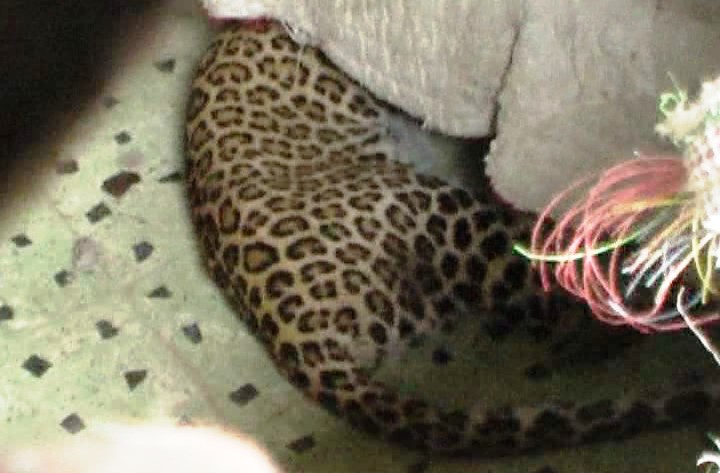
जूनागढ़ के आसपास के इलाकेमें तेंदुवे की तादात इतनी बढ़ गई है की तेंदुवे अब तो घर में भी घुसने लगे है, जूनागढ़ के नागलपुर गाव में एक तेंदुवा दिन दहाड़े बिच बाजार में एक मकान में घुस गया था. घर के अन्दर घुसे तेंदुवे को बहार निकलने में वन विभाग की रेस्क्यू टीम को करीब चार घंटे की मुशक्कत करनी पड़ी थी, 

गुजरात के जूनागढ़ के करीबी गाव नागलपुर के सदभावनगर के इस मकान में आज सुबह सुबह एक बिन बुलाया महेमान घुस गया है, महेमान कोई और नहीं बल्के महेमान एक खूंखार तेंदुवा है, जो दिन दहाड़े इस गाव की गलियों से गुजरते हुवे चिमनभाई राणपरिया के घर मैं घुस गया है. शिकार की तलाश में यह तेंदुवा  गावमें घुस गया था, और बिच बाज़ार से भागता हुवे तेंदुवे को देखकर गाव के लोग इकठ्ठा हो गए और चारो तरफ शोर मच गया और फिर तेंदुवा छलांग लगाकर इस घर मैं घुस गया, तेंदुवे को घर में घुसता हुवा देख कर घर के लोग भी दर गए और कमरे में घुस गए, तेंदुवा भी छलांग लगाकर इस खुले कमरे मैं घुस गया. यहो मौका देखकर चिमनभाई राणपरिया कमरे का दरवाजा बांध करके ताला लगा दिया और वन विभाग को जानकारी दी के उनके घर में एक तेंदुवे घुस गया है.

जैसे ही वन विभाग को को पता चला की ताबड़ तोड़ एक टीम वहा पहोच गई और सभी बातो जा जायजा लेकर सासन गिर से एक खास रेस्क्यू टीम बुलाई और फिर रेस्क्यू टीमने आकर तेंदुवे का निरीक्षण कर के उसे बेहोशी का इंजेक्सन देने की तय्यारी की मगर तेंदुवे ने कमरे के अन्दर अफडा ताफ्दी मचा राखी थी जैसे ही रेस्क्यू टीम तेंदुवे को इंजेक्सन देने की कोशी कसरती थी तेंदुवे खिड़की से जपट्टा मार कर हमले की कोशिश में था मगर करीब चार घंटे की मुशक्कत के बाद तेंदुवे को बेहोशी का इंजेक्शन लग गया और तेंदुवा बेहोश हो गया, फिर उसे पिंजड़े में बांध कर के सासन गिर के अनिमल केर सेंटर में ले जाया गया है. वहा जब होश मैं आएगा उसके बाद उसे फिर से जंगल में छोड़ दिया जाये गा.

शेरो के संरक्षण प्रोग्राम के कारन शेरो के साथ साथ तेंदुवे की संख्य में भी काफी इजाफा हुवा है. पीछे साल हुई गिनती में सब से जादा तेंदुवे की संख्या जूनागढ़ जिले में पाई गई है इस लिए इस इलाकेमें आये दिन तेंदुवे गाव में घुस जाते है और लोगो के ऊपर हमला करदेते है. मगर इस घटने से लोगो में काफी डर बेथ गया है क्यों की पहेले तो सिर्फ रात के समय ही खेतो में तेंदुवे दिखाई देते थे मगर अब तो दिन दहाड़े गाव में और घर में घुस जाना चिंता विषय हो गया है.

Sunday, June 17, 2012

Cricket lions : Pathan brothers visit Gujarat's Gir National Park


JUNAGADH (Gujarat): Cricketers Irfan and Yusuf Pathan visited the sole home of the Asiatic lion, the Gir National Park and Wildlife Sanctuary, with their family here on Sunday. 


The brothers, on a two-day recreational visit after a tiring cricket season, were happy to be in the wildlife park. 

"We saw three lions earlier. They were resting, two of them were sitting and another one was sleeping. Then we saw a family of seven lionesses who were sitting at a place, after that we saw eleven lions and lioness who passed by our vehicle. We felt very good after watching all these things," Yusuf Pathan said. 

The younger Pathan, seen with his father and mother, said that the most interesting part of the trip was a lion killing an animal to feed on, which was a rare spectacle and felt an adrenaline rush. 

"We were feeling good and at the same time we had an adrenaline rush that a lioness was walking so close to us and was staring at us. It passed by my mother who was sitting in the vehicle behind me, I made a video of this incident and I believe that me and my family will never be able to forget this thing throughout my life," said Irfan Pathan. 

Established in 1965, the Gir Forest National Park and Wildlife Sanctuary, also known as Sasan-Gir, is the sole home of the majestic Asiatic lions. 

Besides, Gir harbours around thousand species of birds and 26 species of reptiles. 


v

Wednesday, May 30, 2012

Vulture census begins Junagadh


Vulture census begins Junagadh

Junagadh (Gujarat), May 29 (ANI): Forest officials in the Sasan Gir National Park in Gujarat have begun a two-day census of vultures.

Deputy Conservator of Forest, Gir Forest Sanctuary, Sandeep Kumar, said around 600 forest officials have been deployed to monitor the number of vultures and their behaviour.

"We know the time and are, where the vultures arrive. So, before the time of arrival, the staff takes its place silently in the nearby areas and we try and count the number of adult and child vultures. Along with this, we also note the compositions in which these vultures arrive, we note down the time, the place and silently observe their behaviour. So, this is the kind of observation we do," said Kumar.

Kumar said there are various types of vultures in the forest, including king vulture, long billed vultures, Egyptian vultures and many other species of vultures.

Chief Conservator of Forests (Wildlife), Junagarh R.L. Meena said the number would not decrease and would remain stable.

"The estimation of citing would be declared in a proper way at the state level. As per the citing so far, I feel that the number would not decrease, it would remain stable," said Meena.

According to the 2005 census, 2135 vultures were recorded

According to a report in 2010, two US researchers found that the cause of the unprecedented decline in the population of vultures in India was a veterinary drug residue in cattle and livestock carcasses, which was killing most of the South Asian vultures, leaving them on the brink of extinction.

It was discovered the vultures were being poisoned by residues of an anti-inflammatory drug (diclofenac) used in cattle and other livestock, whose carcasses they feed on.

The anti-inflammatory drug was fed to ailing cattle and other livestock, was being ingested by the wild birds feeding on the carcasses and causing visceral gout, a manifestation of renal failure. (ANI)

Monday, May 28, 2012


Asiatic Lion Populations Outgrowing Their Sanctuary in India


The Asiatic lion once roamed through the Indian subcontinent, Mediterranean, and Middle East, but by 1907, the lions were down to only 13, and the Indian prince banned hunting the massive beasts.
As their populations grow, lions are finding their ways into villages, killing livestock and entering people’s homes. They rarely attack humans, but are often injured as villagers have put up rudimentary measures, like electric fences, to keep the predator from making their livestock prey. According to Scientific American, many conservationists and the Indian government think the smart thing to do is to transfer some of them elsewhere. One location where they are looking is the Kuno Wildlife Sanctuary.
But, Gujarat doesn’t want to lose their lions, as both sides weigh the positives and negatives of relocating the animals.
Everyone agrees that it’s great to see the numbers increasing, but with lions creeping up to 500 and the human population in India growing to 1.2 billion, where will they all go? –Brian McClintock

Friday, May 25, 2012

UP: Gir lions to roar in Mulayam's Etawah


Lucknow: The Uttar Pradesh government has dusted off a 2006 plan to create a miniature version of South Africa's Kruger National Park, whose lion safari draws tourists like a magnet all year round.
Significantly, the Akhilesh Yadav-led Samajwadi Party dispensation has chosen a 50- hectare tract of land in Fisher Forest that lies in Mulayam Singh Yadav's citadel of Etawah. This would be the first ever such project in the state.
Government sources revealed that apart from serving as an attraction for backpackers, the safari will house a lion breeding centre of international standards to augment the captive population of the magnificent Asiatic lion in the country, the Daily Mail reported.
But wildlife experts expressed doubts about the viability of the UP government's ambitious plan.
Conservationist Ananda Banerjee observed: "The first hurdle for the UP government would be procuring lions from its counterpart in Gujarat. The latter has submitted in the Supreme Court that it will not hand over lions to anyone. It refused the Madhya Pradesh government's request in this regard."
Nearly 150 hectares of land in Fisher Forest on Etawah-Gwalior highway, close to the National Chambal Sanctuary and ravines of the Yamuna had been acquired in 2005 during the Mulayam regime and was notified as a Lion Safari. Named after Fisher, collector of Etawah in 1888, the forest lies about 10 km from the Etawah district headquarters. Of the total cost of Rs 5.6 crore, Rs 1.04 crore had been allotted for the safari in 2005.
The project, however, was derailed after Mulayam's exit in 2007 after losing to the BSP.
The land for the project has already been identified in the Fisher Forest area of Etawah. The project would take about two years to complete after the CZA grants approval.
The state government recently sent a request to the Gujarat government asking for a lion and four lionesses needed for natural breeding. The Gir National Park in Junagadh (Gujarat) is the only natural habitat of pure Asian lions in Asia. When the original project had been sent to the CZA in 2005, it had granted approval on the condition that a lion breeding centre be set up as part of the safari.


Tuesday, December 13, 2011

हडमतिया गाव के किसानने लगाये फंदे में फसे तेंदुवे की हुई दर्दनाक मौत

किसानने लगाये फंदे में फसे तेंदुवे की हुई दर्दनाक मौत

रिपोर्ट: हनीफ खोखर, जूनागढ़ - गुजरात.
मंगलवार के दिन एक और तेंदुवे की दर्दनाक मौत हो गई, गुजरात के अमरेली जिले के राजुला के करीब हडमतिया नाम के गाव के एक खेत में किसान ने वयारो के फंदे में फस जाने के कारन तेंदुवे की मौत हो गई है, गिर के जंगल के करीब राजुला तहेसिल के हडमतिया गाव की खेत में यह हादसा हुवा था, तेंदुवे को मौत के घाट उतारने वाले किसान के खिलाफ तेंदुवे की हत्या का मामला दर्ज करके वन विभाग ने किसान को गिरफ्तार कर लिया है. और कोर्ट में पेश कर के रिमांड की भी मांग की है.
गुजरात के अमरेली जिले के राजुला के खिजदिया गाव की खेत में एक और तेंदुवे की दर्दनाक मौत हो गई, किसान नथुभाई वालेराभाई पिंजर के खेत में काम कर रहे उनके भागीदार रमेश काना दोलासिया ने अपने पाक को नुकशान कर रहे भुंड (डूककरो) को फ़साने के लिए मोटर सायकल के क्लच वयारो का फंदा लगाया था मगर इस फंदे में रात के समय डूककरो के बदले तेंदुवा फस गया और उनकी दर्दनाक मौत हो गई, सुबह सुबह खेत में काम करने वाला किसान रमेश काना दोलासिया जब अपनी खेत में काम करने आया तब उसने तेंदुवे की चिल्लाने की आवाज सुनी और उन्होंने देखा तो क्लच वायर में तेंदुवा बुरी तरह से फसा हुवा था और स्टील के तारो से निजत पाने के लिए जुज रहा था, यह देख कर किसान रमेश काना पहेल तो डर गया और फिर बहोत देर के बाद वन विभाग को इस घटना की जानकारी दी मगर जब तक वन विभाग की रेस्क्यू टीम ने वहा पहोचे उनसे पहेले ही तेंदुवे ने दम तोड़ दिया था,
क्लच वायर के फंदे में फसे तेंदुवे को तडपता हुवा देख कर आस पास के खेतो के कई किसान और कई लोग जमा हो गए थे मगर कोई तेंदुवे के पास जाकर बचा नहीं सकता था घंटो तक तेंदुवा तडपता रहा और जीवन के लिए जुजता रहा मगर आख़िरकार वन विभाग की रेस्क्यू टीम आये उस से पहेले कई सो लोगो के सामने ही तेंदुवे ने तडपते तडपते दम तोड़ दिया. वन विभाग के मुताबिक तेंदुवा मादा थी और उनकी उम्र करीब 4 साल की थी क्लच वायरो की जाल में रात से ही फस जाने के कारन करीब दस से बारह घंटे तक फसे रहेने के कारन ही तेंदुवे की मौत हो गई थी, वन विभाग के अमरेली डिविसन के नायब वन संरक्षक जे. के. मकवाना ने बताया की वाइल्ड लाइफ प्रोटेक्सन एक्ट के अनुसार किसान के खिलाफ तेंदुवे की हत्या का मामला दर्ज कर के किसान रमेश काना दोलासिया को गिरफ्तार कर लिया है. तेंदुवा सिलियुल वन की पेरिस्ट में समविस्त है और अति संकटग्रस्त प्रजातियो में से एक है. इस लिए वन विभाग ने किसान को तेंदुवे की हत्या करने जुर्म में गिरफ्तार कर के आज कोर्ट में पेश कर के रिमांड की मांग की है,
भारत सरकार और गुजरात सरकार द्वारा तेंदुवे के संरक्षण के लिए कई प्रोग्राम चलाये जा रहे है और गुजरात का वन विभाग एशियाई शेर और तेंदुवे बचाने की जद्दोजहद के कारन ही गुजरात में तेंदुवे की आबादी बढ़ी है उसमे भी गिर जंगल और आसपास के इस इलाके में तेंदुवे की संख्या भी काफी बढ़ी है. राजुला, सवार कुण्डला और जाफराबाद तहेसिल में तन्दुवे की संख्या बड़ी मात्र बढ़ने के कारन आयेदिन तेंदुवे खेतो और गावो में शिकार की तलाश में आ जाते है और कभी कभा इस तरह की मानव भूल तेंदुवे और शेर जेइसे प्राणियों के लिए मौत का फंदा बनजाता है.